
When your joints are healthy, you likely don’t think about the intricate mechanics that allow your hips to swing or your shoulders to rotate. But the moment a sharp, burning pain radiates from your hip or lower back, you become acutely aware of a tiny but vital structure: the bursa.
At JointGlow, we see many patients struggling with chronic inflammation of these structures—specifically trochanteric bursitis and bursitis of the hip. If you’ve been told your only options are waiting it out or repeated steroid injections, it’s time to understand the anatomy of your pain and how low-dose radiotherapy (LDRT) offers a superior biological solution.
The Anatomy of a Bursa: Your Joint’s Shock Absorber
To understand bursitis, you first have to understand what a bursa is. Imagine a small, fluid-filled sac that acts as a cushion between bones and soft tissues (like tendons and muscles). Its job is to reduce friction. Without these shock absorbers, your tendons would rub painfully against your bone every time you moved.
In the hip, the most commonly affected area is the greater trochanter—the bony prominence on the outer side of your femur. When the sac covering this bone becomes inflamed, it is known as trochanteric bursitis.
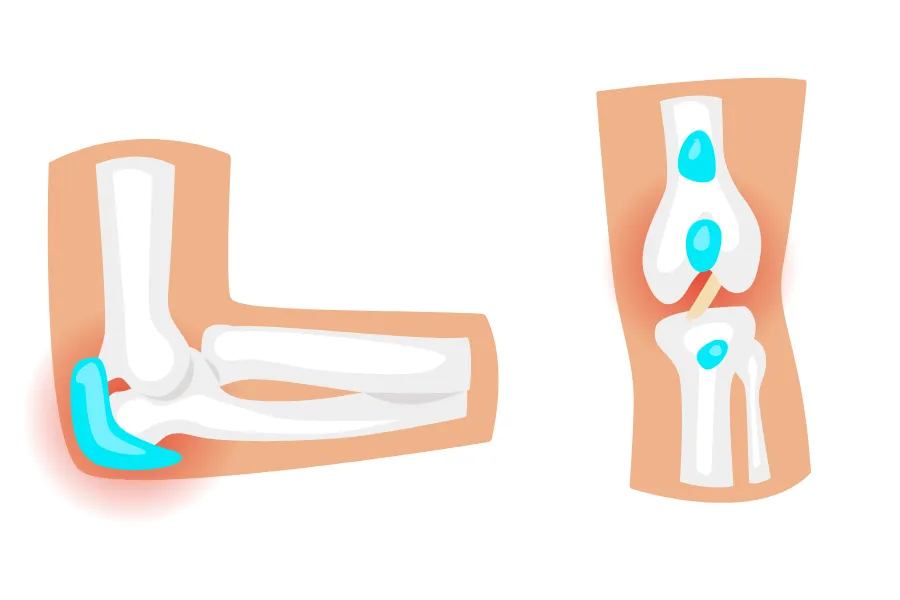
Why the Bursa Inflames: The Cycle of Chronic Pain
Bursitis isn’t always caused by a single injury. More often, it is the result of repetitive stress or underlying biomechanical issues, such as:
- Overuse: Repetitive motion from running, cycling, or standing for long periods.
- Hip Injuries: A fall onto the side of the hip can compress the bursa.
- Spine Issues: Scoliosis or arthritis in the lower spine can change the way you walk, leading to SI pain (sacroiliac joint pain) and subsequent hip inflammation.
Once the bursa is inflamed, the body sends immune cells to the area. In a healthy scenario, the inflammation subsides. However, in chronic cases, the immune response gets stuck. The bursa thickens, the fluid increases, and the pain becomes a constant companion, especially when lying on your side at night.
Traditional Hip Bursa Treatment vs. The JointGlow Approach
Standard hip bursa treatment often starts with NSAIDs (like ibuprofen) or physical therapy. If those fail, many doctors recommend a cortisone injection. While steroids provide temporary relief, they don’t always reset the biological environment of the joint, and the pain often returns once the medication wears off.
How LDRT Reduces Inflammation
Low-dose radiotherapy (LDRT) at JointGlow works differently. Instead of just masking the pain, LDRT uses ultra-low energy waves to interact with the cells at the site of the inflammation.
- Cellular Modulation: LDRT shifts the local immune cells from a pro-inflammatory state to an anti-inflammatory state.
- Systemic Response: It calms the overactive signaling molecules (cytokines) that keep the bursa in a state of constant irritation.
- Precision Targeting: We focus the energy specifically on the inflamed bursa, providing deep-tissue relief that physical therapy or topical creams simply cannot reach.
What’s the Connection Between SI Pain Relief and Hip Health?
Many patients who seek SI pain relief discover that their lower back issues are actually contributing to their hip bursitis. Because the body is an interconnected system, inflammation in the sacroiliac joint can cause you to shift your weight, putting undue pressure on the hip bursa.

By treating the inflammatory source with LDRT, JointGlow helps restore the natural balance of your gait and reduces the overall systemic fire in your joints.
FAQ: Understanding Bursitis and LDRT
How do I know if I have hip bursitis or a hip joint problem?
Bursitis usually causes pain on the outside of the hip that is sensitive to touch. Pain inside the groin or deep in the joint is more often related to osteoarthritis of the hip joint itself. LDRT is effective for treating both.
Is LDRT safe for treating soft tissue like a bursa?
Absolutely. LDRT is a non-invasive, needle-free treatment. The doses used are extremely low—similar to a standard diagnostic X-ray—and are specifically calibrated to treat inflammation without damaging the surrounding muscle or bone.
How long does it take to see results for trochanteric bursitis?
While some patients feel a decrease in burning sensations within the first few sessions, the full biological effect usually peaks 4–8 weeks after the treatment course is completed.
Will I need to stop physical therapy during LDRT?
No. In fact, many patients find that LDRT reduces their pain enough to make their physical therapy exercises significantly more effective and less painful to perform.
Reclaim Your Mobility With JointGlow
Don’t let chronic bursitis keep you from a full night’s sleep or an active afternoon. If you are tired of temporary fixes and are looking for a scientifically-backed hip bursa treatment, JointGlow is here to help. Our LDRT protocols are designed to treat the root cause of your inflammation, providing long-term relief without the need for surgery or ongoing injections.Are you ready to extinguish the fire of chronic inflammation? Contact JointGlow today to schedule your LDRT consultation and take the first step toward pain-free movement.