How the Low Dose Radiation Mechanism Can Calm Joint Inflammation
Chronic joint pain can persist when the immune system continues signaling a joint long after the original injury or irritation. Those ongoing signals produce pain, stiffness and limited movement. The low dose radiation mechanism interrupts that signaling at the cellular level with a precise, ultra-low dose of energy, calming the inflammatory response and allowing the joint to begin recovering.
If you are an active adult aged 50 or over, have lived with joint pain for years and have already seen a specialist—whether you have had joint surgery or are trying to avoid it—the practical question is whether LDRT is worth your time. Here is the basic idea:
- You walk in, lie down and receive treatment to the painful joint for approximately five minutes, then walk right back out. There are no needles, no anesthesia and no recovery period.
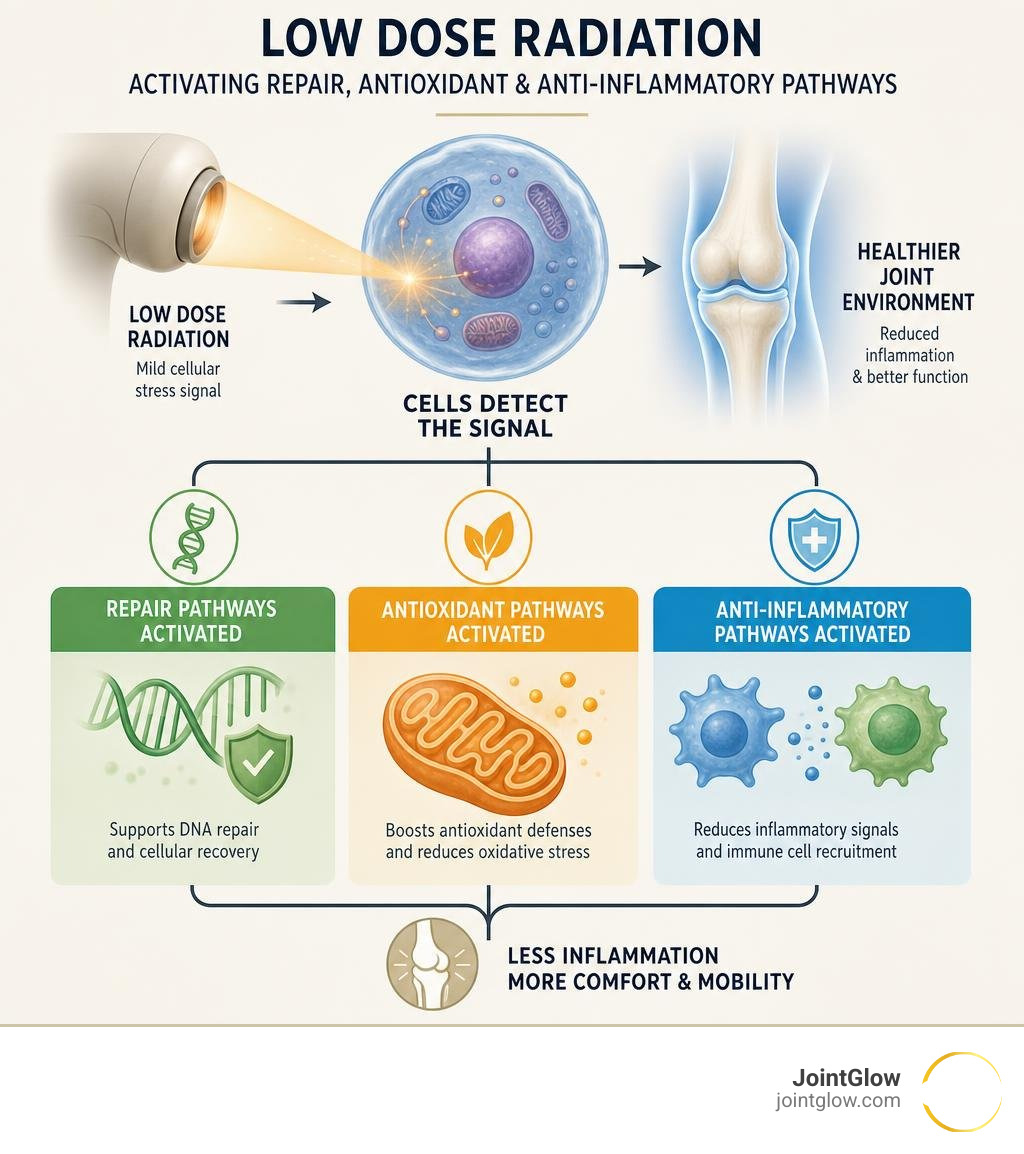
- Cells detect the exposure and activate stress-response systems, including DNA-repair and antioxidant pathways.
- Immune signaling can change, with less activity from inflammatory messengers and adhesion signals that draw immune cells into tissue.
- Over time, this may reduce inflammation-related pain and support more comfortable movement.
Low-dose radiation therapy, or LDRT, is studied for its ability to change immune activity and reduce inflammation. Researchers are examining ATM, a protein involved in responding to DNA damage; Nrf2, a protein that helps activate antioxidant defenses; mitochondria, the cell’s energy-producing structures; and macrophages, immune cells that can promote or calm inflammation.
These effects are not automatic or identical for every person. Dose, treatment schedule, tissue type, underlying condition, and individual biology all matter. This guide explains how the proposed pathways work and what they may mean for chronic joint inflammation.
Understanding the Low Dose Radiation Mechanism in Biological Systems
To understand LDRT, start with what happens when radiation transfers energy to cells in the treated joint. Researchers study how those cells respond and whether the response can help calm inflammation.
JointGlow states: “The dose used in each session is ultra-low, specifically calibrated to address joint inflammation while remaining well below thresholds associated with any meaningful risk.” Researchers study adaptive responses: changes that help cells respond to a small stress signal. Mitchel, 2006 discusses responses involving DNA repair and proteins that help other proteins keep their working shape.
Hormesis: How Cell Responses Can Change With Dose
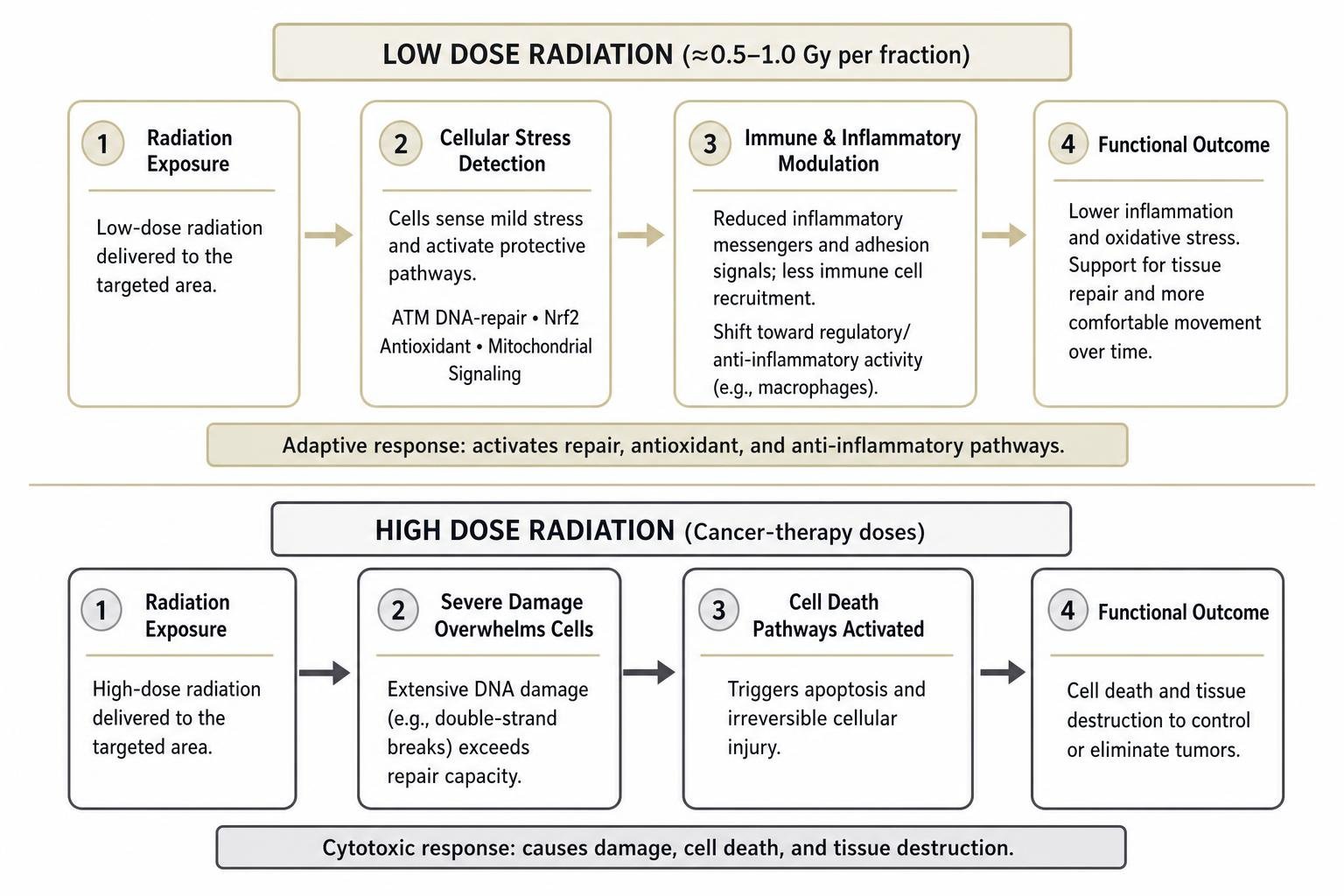
Radiation hormesis is the hypothesis that small radiation exposures can stimulate protective cell responses. Researchers examine how these responses change with dose. This hypothesis is not a substitute for radiation-safety guidance.
JointGlow describes its treatment as a precise, ultra-low dose of energy calibrated to address joint inflammation.
Another research topic is low-dose hypersensitivity, meaning that some cells are unusually sensitive to small radiation exposures. Cell-level findings do not by themselves predict how much pain relief an individual will experience.
ATM: A Repair-Signaling Protein That Moves Into the Cell Nucleus
Le & Foray, 2023 discuss ATM, a protein involved in DNA-damage signaling. Their proposed mechanism involves ATM moving from the cytoplasm—the area outside the cell nucleus—into the nucleus, where DNA is stored.
When low-dose radiation interacts with the cytoplasm:
- Reactive oxygen species (ROS), chemically reactive oxygen-containing molecules, provide a signal.
- In the proposed mechanism, paired ATM proteins separate, and individual ATM proteins move into the nucleus.
- ATM helps signal DNA damage and coordinate repair, including a process that joins broken DNA ends.
Researchers are examining how this movement of ATM relates to cell repair and inflammation. It is one proposed part of LDRT’s biological response, rather than a guarantee of relief.
How Low-Dose Radiation Regulates Key Inflammatory Pathways
Inflammation can contribute to persistent pain in osteoarthritis, synovitis (inflammation of the joint lining) and tendonitis (inflammation of a tendon). Immune signals can keep reinforcing one another instead of switching off. JointGlow’s the science of inflammation LDRT at the cellular level describes proposed effects on these signals.
Macrophages: Shifting Immune Cells From Inflammation Toward Repair
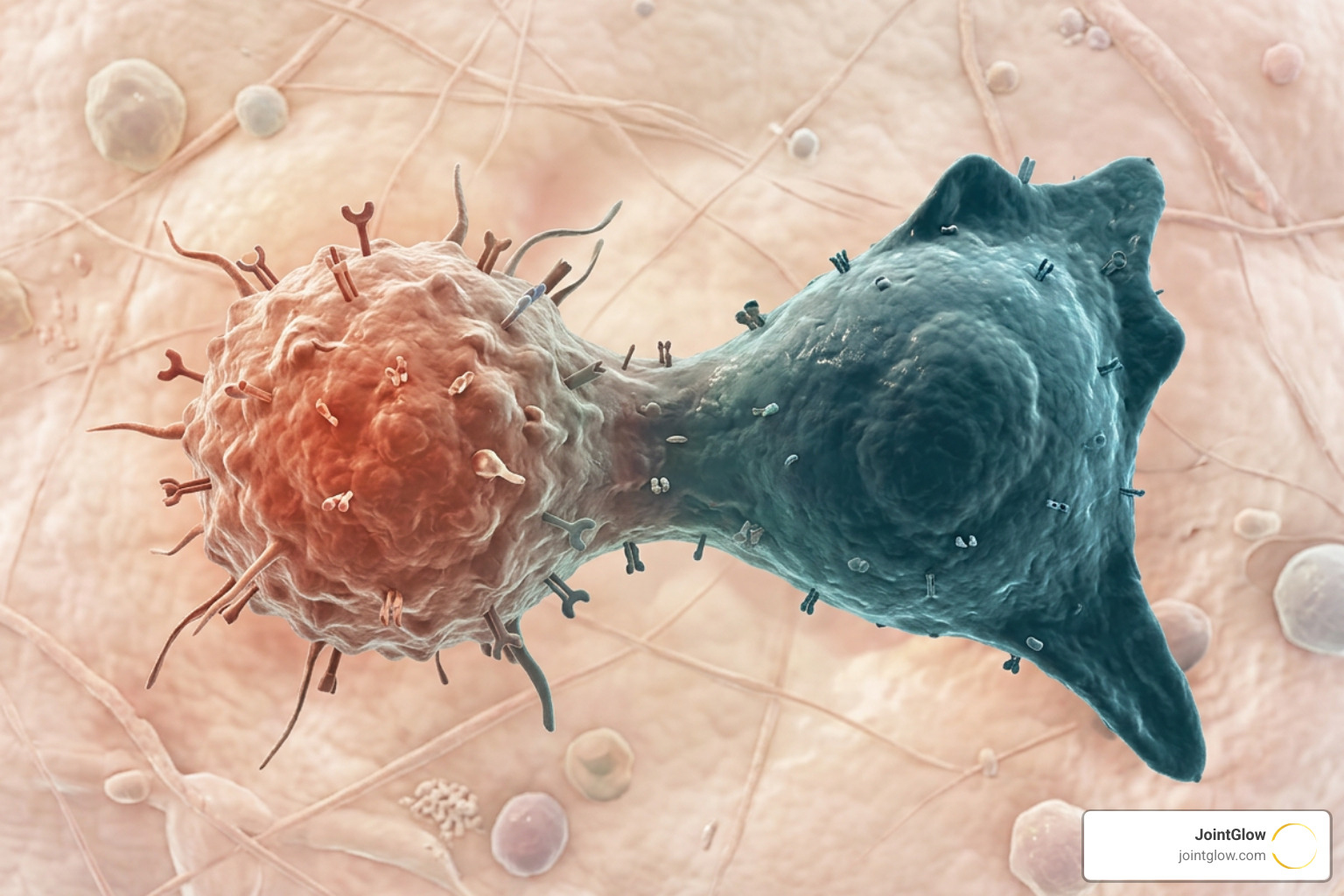
Macrophages are immune cells involved in joint inflammation and repair. In an inflamed joint, some take on an M1, or inflammation-promoting, state. They release cytokines—chemical messages between cells—and can produce nitric oxide through an enzyme called iNOS.
LDRT may change the local conditions in the joint by encouraging macrophages to shift their activity:
- Less inflammation-promoting activity: Researchers examine reductions in iNOS activity and nitric oxide production.
- More repair-oriented activity: Macrophages may shift toward an M2 state, associated with resolving inflammation. Arginase-1 is an enzyme used as a marker of this activity.
- Changes in immune messages: Researchers also examine TGF-beta and IL-10, chemical signals involved in regulating inflammation.
Nrf2: Activating the Cell’s Antioxidant Defenses
Oxidative stress occurs when reactive molecules overwhelm a cell’s defenses, and it can contribute to tissue damage in an inflamed joint. Guéguen et al., 2019 review cellular adaptive responses and antioxidant pathways, including the role of Nrf2, a protein that helps activate antioxidant defenses.
Keap1 is a protein that normally helps keep Nrf2 activity in check. Researchers study how radiation-related chemical signals affect Keap1 and allow Nrf2 to activate antioxidant defenses:
- Nrf2 moves into the nucleus.
- It attaches to DNA regions that help switch on protective genes.
- These genes support production of the cell’s own antioxidant enzymes, including HO-1, superoxide dismutase and catalase.
These antioxidant defenses help control free radicals—highly reactive molecules that can damage cells—and maintain chemical balance within cells.
Reducing Inflammatory Messages and Immune-Cell Attachment
Another proposed effect involves how white blood cells enter an inflamed joint. Proteins on the inner lining of small blood vessels help these cells attach and move into the space around the joint.
Researchers examine whether LDRT reduces activity of NF-kappa B, a protein complex that helps switch on genes involved in inflammation. Proposed effects include:
- Fewer inflammatory messages: Changes in TNF-alpha and IL-1 beta, two inflammation-promoting cytokines.
- Less immune-cell attachment: Changes in VCAM-1, ICAM-1 and E-selectin, proteins that help white blood cells attach to blood-vessel walls.
- Less immune-cell entry: Reduced movement of white blood cells from vessels into the joint.
These proposed mechanisms help explain why LDRT is studied for a range of targeted conditions, including osteoarthritis, plantar fasciitis and chronic tendon conditions. Clinical benefit can vary by condition and individual.
Mitochondria and Signals to Neighboring Cells
Mitochondria, the cell’s energy-producing structures, also play a role in responses to radiation. Research on mitochondrial control of non-targeted radiation effects examines how low-dose radiation can affect how mitochondria produce energy and how cells communicate.

Mitophagy: Clearing Damaged Mitochondria
In cells of an inflamed joint lining, damaged mitochondria can become less efficient at producing energy and release excess reactive oxygen species.
Low-dose radiation acts as a quality-control trigger:
- Identifying damage: PINK1 and Parkin, proteins involved in mitochondrial quality control, help mark damaged mitochondria.
- Clearing damaged structures: The cell encloses them in small compartments for breakdown. This cleanup is called mitophagy.
- Maintaining energy production: Removing damaged mitochondria helps the cell maintain its energy-producing structures.
Intercellular Communication and the Low Dose Radiation Mechanism in Tissue Repair
Researchers also study ‘bystander effects’: responses in neighboring cells that were not directly exposed to radiation. Cells may communicate through several routes:
- Message-carrying packets: Exosomes are tiny packets released by cells that can carry molecules affecting neighboring cells.
- Cell-to-cell connections: Tunneling nanotubes are narrow connections through which cells can exchange material, including mitochondria.
- Other proposed signals: Researchers also examine chemical messages and very weak light emissions from cells. Their relevance to joint-pain relief remains a research question.
What the Science Means for Your LDRT Treatment
For someone deciding whether to try another treatment, the practical questions are how LDRT is delivered, what a session involves and what its safety record shows. JointGlow describes energy localized strictly to the joint space. Each session takes approximately five minutes: you walk in, lie down and walk right back out, with no needles, no anesthesia and no recovery period. Learn more about how it works and our LDRT treatment. Patients can find LDRT services certified by JointGlow at the JointGlow center in Winter Park, FL, and through six independently operated medical practices that partner with JointGlow and are certified to offer JointGlow services in Lafayette, LA; Lake City, FL; New Iberia, LA; Opelousas, LA; and Oviedo, FL.
Treatment Sessions and Safety
JointGlow describes treatment as 6–10 sessions over 2–3 weeks. Its treatment page states: “The dose used in each session is ultra-low, specifically calibrated to address joint inflammation while remaining well below thresholds associated with any meaningful risk.” Each session takes approximately five minutes. You walk in, lie down and walk right back out, with no needles, no anesthesia and no recovery period.
What should you know about the treatment course?
- A series of short sessions: JointGlow delivers treatment over multiple visits while the inflammatory response changes over time.
- Safety record: JointGlow states: “In the published research, serious adverse events are exceptionally rare.” Its treatment page also says: “The most commonly reported experience after a session is mild, temporary warmth or achiness at the treatment site, which typically resolves within a day.”
- Outpatient ease: Each session takes approximately five minutes. You walk in, lie down and walk right back out. There are no needles, no anesthesia and no recovery period.
Frequently Asked Questions About Low-Dose Radiation
How does LDRT address joint inflammation?
JointGlow describes LDRT as a precise, ultra-low dose of energy delivered to the affected joint. It interrupts persistent immune signaling at the cellular level, calming inflammation and allowing the joint to begin recovering.
When might I notice pain relief after LDRT?
Cellular changes and noticeable pain relief are not the same thing. JointGlow explains that calming inflammation takes time; its treatment page says most patients report meaningful improvement within 2–6 weeks. Individual results vary. Sessions take approximately five minutes: you walk in, lie down and walk right back out, with no needles, no anesthesia and no recovery period.
Is low-dose radiation therapy safe for chronic joint conditions?
JointGlow states: “In the published research, serious adverse events are exceptionally rare.” Its treatment page also says: “The most commonly reported experience after a session is mild, temporary warmth or achiness at the treatment site, which typically resolves within a day.” Each session takes approximately five minutes. You walk in, lie down and walk right back out. There are no needles, no anesthesia and no recovery period.
Conclusion
For someone who has spent years managing joint pain, the key idea is that LDRT targets persistent inflammation at the cellular level. Researchers study changes in immune-cell activity, antioxidant defenses and repair signaling to understand how it may help. Those mechanisms do not guarantee the same result for every person.
At JointGlow, our mission is to harness these biological reset mechanisms to help individuals reclaim their active lives without surgery or a recovery period. Each LDRT session takes approximately five minutes: you walk in, lie down and walk right back out, with no needles and no anesthesia. If you or a loved one is navigating chronic joint pain, review the LDRT results timeline and when to expect maximum relief to understand how our non-invasive, Medicare Part B (Excludes Medicare Advantage) covered protocols can help restore comfortable, pain-free movement.
References
Le Reun E, Foray N. “Low-Dose Radiation Therapy (LDRT) against Cancer and Inflammatory or Degenerative Diseases: Three Parallel Stories with a Common Molecular Mechanism Involving the Nucleoshuttling of the ATM Protein?.” Cancers, 2023. PMCID PMC10000719. Mitchel RE. “Low doses of radiation are protective in vitro and in vivo: evolutionary origins..” Dose-response : a publication of International Hormesis Society, 2006. PMCID PMC2477669. Guéguen Y, Bontemps A, Ebrahimian TG. “Adaptive responses to low doses of radiation or chemicals: their cellular and molecular mechanisms..” Cellular and molecular life sciences : CMLS, 2019. PMCID PMC11105647.
