Knee Pain Medicare Coverage: What Medicare May Pay For
Medicare may cover knee pain care when it is medically necessary. This can include doctor visits, X-rays and other imaging, physical therapy, certain knee braces, outpatient treatments, and knee replacement surgery when less invasive care has not worked. Your costs depend on the treatment setting and your plan.
- Original Medicare Part B usually covers outpatient exams, imaging, therapy, and durable medical equipment. After the Part B deductible, you typically pay 20% of the Medicare-approved amount.
- Part A may apply when medically necessary knee surgery requires an inpatient hospital stay.
- Medicare Advantage plans must cover at least what Original Medicare covers, but may require prior authorization, use in-network providers, and set their own copays.
- Part D may help pay for eligible prescription drugs used before or after treatment.
For knee pain Medicare coverage, ask your clinician to document your diagnosis, pain level, limits on daily activities, imaging results, and treatments you have already tried. Then confirm the facility, clinician, and treatment are covered before you schedule care.
I am Dr. Koneru, and this guide walks through the main covered care paths and the out-of-pocket costs to check first.
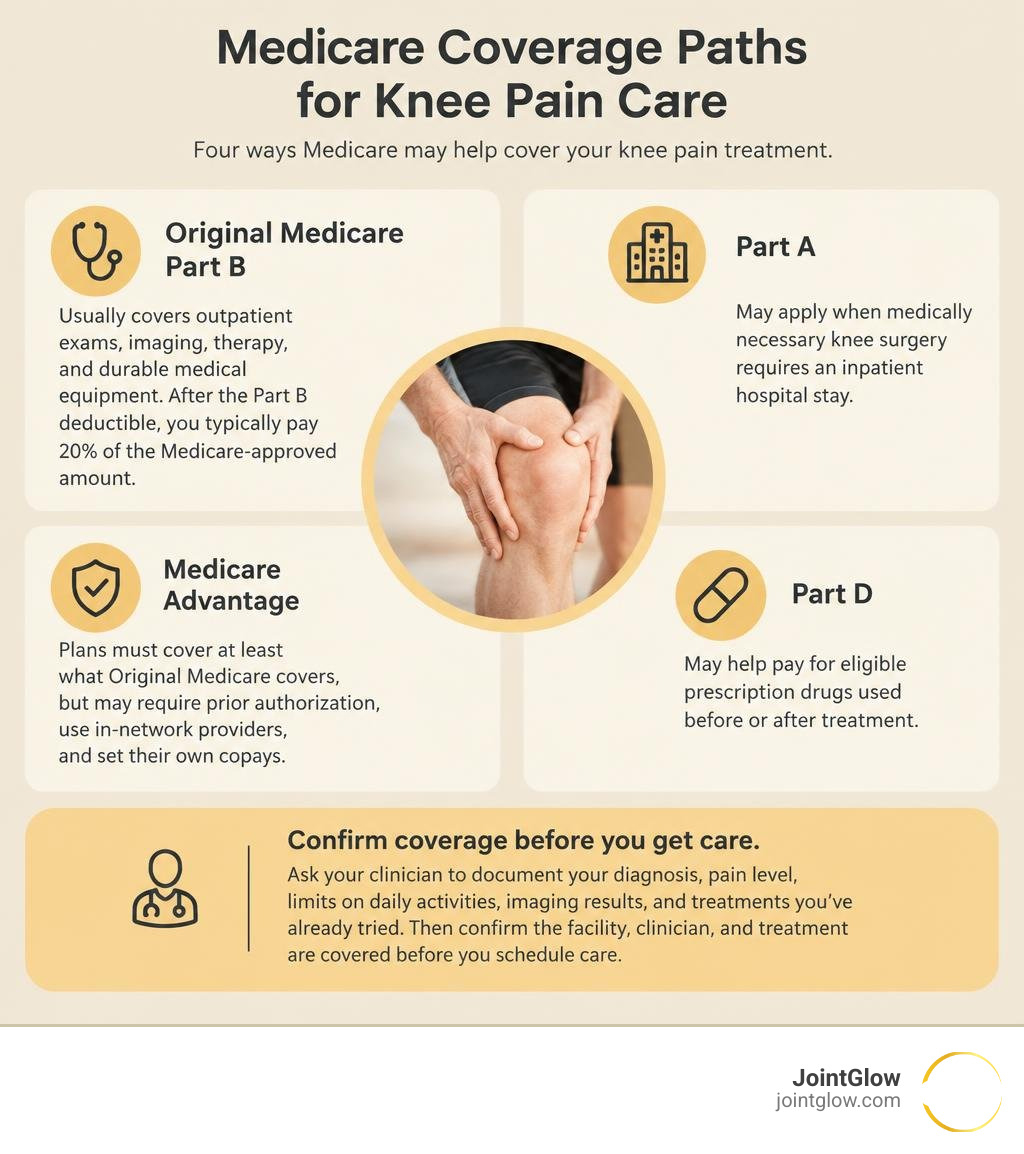
4 Medicare Coverage Categories for Knee Pain

Navigating Medicare to treat persistent knee discomfort does not have to feel like wandering through a bureaucratic labyrinth. When chronic inflammation or cartilage wear limits your mobility, Medicare evaluates care through distinct benefit categories. Understanding these buckets helps you access effective treatments for chronic knee conditions while protecting your savings from surprise expenses.
Diagnostic Imaging, Physical Exams, and Specialist Consultations
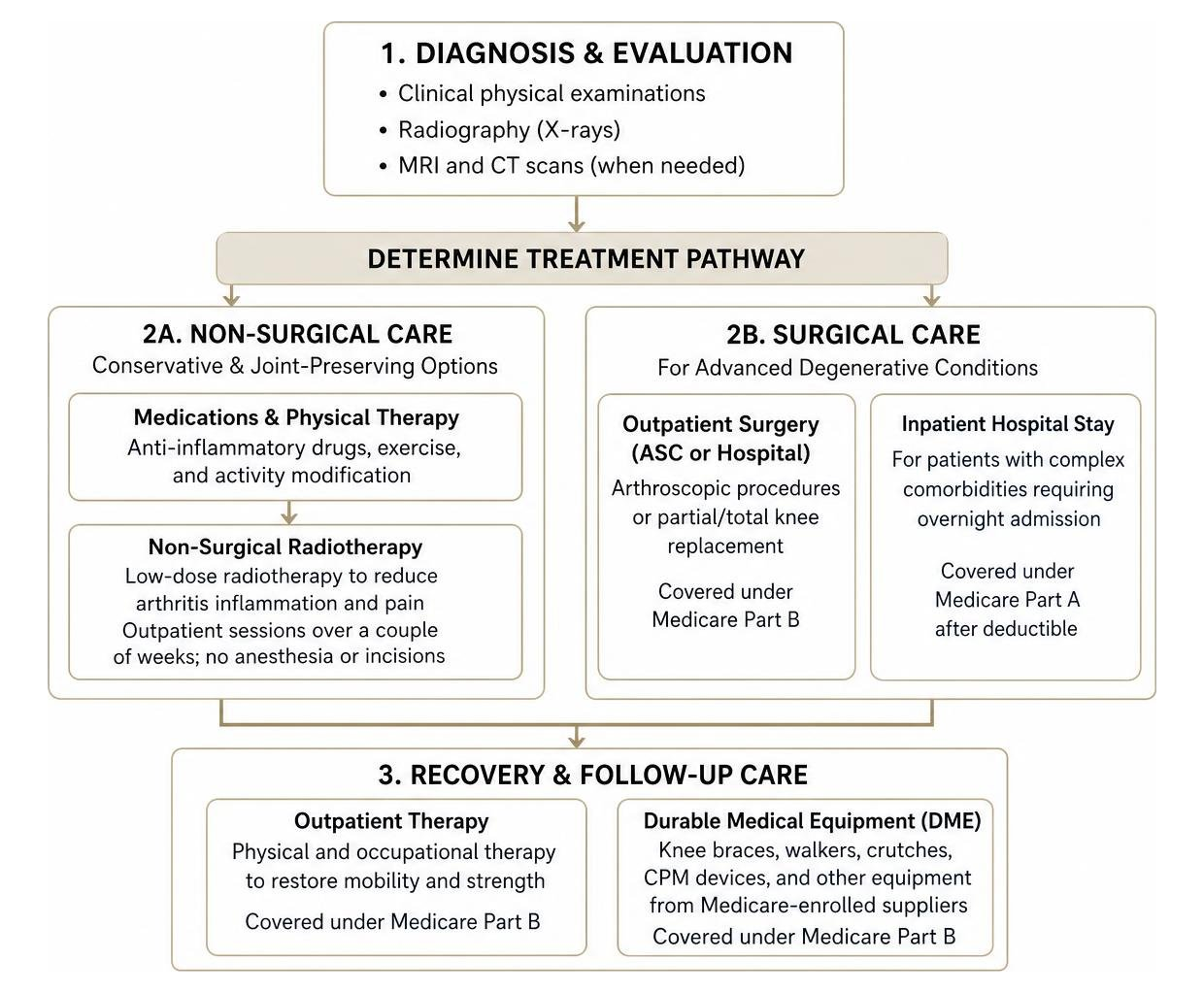
Your journey to finding relief begins with diagnosing the root source of the joint degradation. Under Medicare Part B (Medical Insurance), outpatient diagnostic services are standard covered benefits when ordered by an enrolled physician:
- Clinical Physical Examinations: Initial and follow-up evaluations by primary care physicians, rheumatologists, and orthopedic specialists.
- Radiography (X-rays): Standard weight-bearing views used to evaluate joint space narrowing, subchondral sclerosis, and bone spur formation.
- Magnetic Resonance Imaging (MRI) and CT Scans: Advanced imaging ordered when plain radiographs do not fully explain severe soft-tissue pathology or mechanical locking.
For these services, you are responsible for the annual Part B deductible ($257 in recent baseline schedules). Once you satisfy that deductible, Medicare pays 80% of the Medicare-approved amount, leaving you with a standard 20% coinsurance unless you carry supplemental coverage.
Non-Surgical Radiotherapy for Chronic Arthritis Inflammation
When oral anti-inflammatory drugs cause stomach irritation and physical therapy plateaus, patients often assume high-risk surgery is their only remaining alternative. However, non-invasive therapeutic radiation represents an established, outpatient pathway covered under Medicare Part B.
At JointGlow, we harness low-dose radiotherapy delivering non-surgical joint relief to halt the destructive cellular cycles driving chronic osteoarthritis. Unlike high-dose cancer treatments, this non-invasive therapy uses ultra-low doses of ionizing energy to modulate inflammatory cytokines, dampening pain signals and restoring joint ease.
Understanding how low-dose radiotherapy works helps patients appreciate why the procedure requires zero anesthesia, incisions, or extended downtime. Treatment consists of a quick series of brief outpatient sessions over a couple of weeks. When evaluating your recovery, reviewing the clinical timeline for arthritis pain relief shows that biological anti-inflammatory effects continue to build over several months post-treatment, making it a covered, joint-preserving intervention.
Hospital-Based Knee Care
For advanced degenerative conditions where joint mechanics are severely compromised, Medicare covers hospital-based interventions ranging from arthroscopic evaluations to partial and total joint arthroplasty (TKA).
Coverage rules shift based on where your procedure takes place:
- Outpatient Hospital and Ambulatory Surgery Centers (ASCs): Medicare approved total knee replacements in outpatient surgery settings, allowing healthy candidates to recover at home the same day. These procedures fall under Part B, covering surgical fees, facility costs, and post-operative monitoring.
- Inpatient Hospital Stays: If complex comorbidities (such as cardiovascular conditions or severe sleep apnea) necessitate an overnight hospital admission, Medicare Part A (Hospital Insurance) covers the room, nursing, and inpatient medications after you meet the Part A hospital deductible.
Medicare Coverage Documentation and Follow-Up
Medicare coverage does not stop when you walk out of the clinic or operating suite. Post-intervention recovery protocols are essential for sustaining joint mobility:
- Outpatient Physical and Occupational Therapy: Covered under Part B when prescribed to restore range of motion and muscular strength. While statutory therapy caps were permanently removed, clinics must append appropriate medical necessity modifiers if treatment exceeds standardized thresholds.
- Durable Medical Equipment (DME): Rigid and semi-rigid knee braces, walkers, crutches, and Continuous Passive Motion (CPM) devices can be covered under Part B. To secure reimbursement, the equipment must be purchased through a Medicare-enrolled supplier and meet strict documentation rules outlined in the LCD for Knee Orthoses (L33318) and companion Knee Orthoses Policy Article (A52465).
Medical Necessity Guidelines and Clinical Endpoints for Knee Interventions

Medicare does not approve advanced knee interventions purely based on subjective discomfort. The Centers for Medicare & Medicaid Services (CMS) and regional Medicare Administrative Contractors (MACs) enforce precise clinical criteria to verify that every procedure is reasonable and necessary. This rigorous standard is detailed in policies like LCD – Total Joint Arthroplasty (L40232) and LCD – Total Knee Arthroplasty (L36575), leading many to explore why physicians reconsider radiotherapy for joint pain when invasive surgery carries significant medical hurdles.
Documentation Rules and Treatment History
Before Medicare authorizes specialized treatments or surgical reconstruction, your medical record must substantiate a comprehensive non-surgical trial. Standard coverage guidelines typically require:
- Conservative Therapy Duration: Documented participation in conservative care—such as physical therapy, structured home exercise, NSAIDs, or intra-articular injections—for at least three consecutive months without sufficient functional improvement.
- Functional Impairment: Clear physician notes detailing how knee pain impedes basic Activities of Daily Living (ADLs), such as walking across a room, climbing stairs, or standing to prepare meals.
- Comorbidity Optimization: Documentation confirming that modifiable risk factors (e.g., uncontrolled diabetes, severe obesity, active nicotine use) have been clinically managed to minimize procedural risks.
Medical Necessity Rules for Knee Joint Care
For structural and surgical interventions, objective diagnostic criteria must corroborate your physical symptoms:
- Radiographic Validation: Plain weight-bearing X-rays must demonstrate Kellgren-Lawrence Grade 2, 3, or 4 degenerative changes. Typical findings include observable joint space narrowing, subchondral bone sclerosis, marginal osteophyte growth, or subchondral cyst development.
- Exclusion of Absolute Contraindications: Medicare mandates screening to rule out active systemic bacteremia, local cutaneous infections at the treatment site, or severe progressive neurological conditions that compromise limb stability.
Key Clinical Endpoints Evaluated by CMS
When CMS reviews treatment efficacy and sets national coverage parameters, it relies on standardized, validated measurement tools rather than anecdotal pain reports. As outlined in the Medicare Coverage Document on Knee Osteoarthritis Clinical Endpoints, the agency prioritizes specific patient-reported and clinician-administered outcome domains:
- WOMAC (Western Ontario and McMaster Universities Osteoarthritis Index): Evaluates multidimensional pain, joint stiffness, and physical disability.
- VAS (Visual Analog Scale): Provides continuous tracking of subjective pain intensity from 0 to 100 mm.
- KOOS (Knee Injury and Osteoarthritis Outcome Score): Assesses pain, symptoms, daily function, recreational capacity, and knee-related quality of life.
- EQ-5D-5L: Measures broader health-related quality of life dimensions to determine the overall utility and impact of the therapy.
Out-of-Pocket Cost Breakdown Across Medicare Plans
Understanding how your benefits divide expenses ensures you are never surprised by medical bills. Below is a direct comparison of how different Medicare pathways handle knee pain diagnostics, non-surgical therapy, and joint reconstruction:
| Benefit Category | Original Medicare (No Supplement) | Original Medicare + Medigap (e.g., Plan G) | Medicare Advantage (Part C) |
|---|---|---|---|
| Specialist Office Visits | 20% coinsurance after Part B deductible | $0 out-of-pocket after Part B deductible | $20 – $50 copay per visit |
| Diagnostic X-rays & MRIs | 20% coinsurance | $0 out-of-pocket | $30 – $150 copay depending on scan type |
| Outpatient LDRT Sessions | 20% coinsurance under Part B | $0 out-of-pocket | Set specialist/radiotherapy copay per fraction |
| Inpatient Surgery (Part A) | $1,676 deductible per benefit period | Deductible fully covered | Flat daily copay (e.g., $300/day, Days 1–5) |
| Outpatient Knee Surgery (Part B) | 20% of surgery and facility costs | $0 out-of-pocket | Fixed copayment ($200 – $400 typical) |
| DME (Knee Braces / Walkers) | 20% of approved DME allowance | $0 out-of-pocket | 10% – 20% coinsurance |
| Maximum Out-of-Pocket Cap | No annual limit | Medigap caps your medical risk | Capped annually (typically $4,000 – $8,850) |
Original Medicare Deductibles and 20% Coinsurance
Under Original Medicare, your expenses are divided between Part A and Part B:
- Part B Deductible & Coinsurance: You pay the initial Part B deductible ($257 in recent baseline schedules). After that, you are responsible for 20% of all physician fees, outpatient radiation treatments, physical therapy visits, and imaging scans. Because Original Medicare lacks an out-of-pocket maximum, that 20% can add up significantly during complex surgical care unless you have a supplemental Medigap plan.
- Part A Benefit Periods: If admitted as an inpatient, you pay the Part A deductible ($1,676) for that benefit period, which covers hospital room and board for the first 60 days.
Medicare Advantage Coverage and Extra Benefits
Medicare Advantage (Part C) plans replace Original Medicare administration with private managed care networks. While these plans are legally required to offer coverage equivalent to Parts A and B, their cost-sharing mechanisms differ:
- Copayments vs. Coinsurance: Instead of an un-capped 20% fee, you generally pay fixed copayments for specialist consults, advanced imaging, and outpatient hospital services.
- Network Boundaries: You must utilize in-network orthopedic specialists and facilities to secure maximum plan coverage, unless you are enrolled in an out-of-network PPO option.
- Prior Authorization: Most Advantage plans require advance clinical approval before scheduling advanced imaging, radiation therapies, or surgical procedures.
- Supplemental Recovery Perks: Some Advantage plans provide value-added benefits not found in Original Medicare, such as rides to physical therapy appointments, home-delivered meals during post-operative recovery, or over-the-counter wellness allowances.
Facility-Based and Follow-Up Care Costs
If you require rehabilitation after intensive treatment, Medicare Part A provides coverage for Skilled Nursing Facilities (SNFs)—provided you meet the qualifying 3-day inpatient hospital stay requirement. For days 1 through 20 in an SNF, your copay is $0. For days 21 through 100, you pay a daily coinsurance rate, after which all costs become the patient’s responsibility.
Frequently Asked Questions About Medicare Coverage for Knee Pain
Does Medicare cover medically necessary knee treatment at any age?
Yes. While Medicare primarily serves adults aged 65 and older, individuals under 65 qualify for full Medicare coverage if they receive Social Security Disability Insurance (SSDI) for at least 24 months or are diagnosed with End-Stage Renal Disease (ESRD) or Amyotrophic Lateral Sclerosis (ALS). Regardless of your age of qualification, all knee treatments must satisfy the same standardized medical necessity criteria, diagnostic thresholds, and conservative treatment history.
How much do you pay out of pocket for outpatient knee care?
If you have Original Medicare without a supplemental Medigap plan, you first pay the annual Part B deductible ($257). Once that threshold is satisfied, you pay 20% of the Medicare-approved amount for every outpatient clinical consultation, imaging series, physical therapy appointment, or non-invasive radiotherapy session. If you have a Medigap plan (such as Plan G), it pays your 20% coinsurance balance in full. Patients enrolled in Medicare Advantage plans typically pay fixed copayments ranging between $20 and $50 per outpatient specialist encounter.
What steps should you take if Medicare denies a knee treatment claim?
A denial is not the end of the road. If Original Medicare or a Medicare Advantage plan denies coverage for a knee therapy, follow these systematic appeal steps:
- Examine the Explanation of Benefits (EOB) or Denial Notice: Identify whether the denial stems from missing administrative documentation, an unapproved billing code, lack of prior authorization, or unmet medical necessity criteria.
- Request a Redetermination: File a formal Level 1 Redetermination request within the timeframe specified on your denial notice (typically within 120 days of receiving your Medicare Summary Notice).
- Submit Additional Objective Evidence: Work with your doctor to provide detailed clinical notes, including Kellgren-Lawrence radiographic scores, comprehensive records of your prior conservative therapies, physical exam notes demonstrating functional limitations, and a personalized letter of medical necessity.
- Escalate if Necessary: If the Level 1 appeal is upheld, you can request an independent reconsideration by a Qualified Independent Contractor (QIC) or Administrative Law Judge (ALJ).
Conclusion
Chronic knee pain should not dictate your quality of life, nor should the fear of medical bills prevent you from finding durable relief. Medicare offers dependable coverage paths for comprehensive knee care—ranging from non-invasive therapeutic treatments and durable support braces to advanced joint replacement.
By understanding your specific plan rules, maintaining meticulous clinical documentation of your symptoms and prior therapies, and selecting established, covered options, you can regain comfortable joint function without unnecessary out-of-pocket stress. Explore JointGlow’s Medicare-covered joint pain care to discover how non-surgical, anti-inflammatory therapies can restore your active mobility.
