Sudden Hip Pain Without Injury in Women: What It May Mean
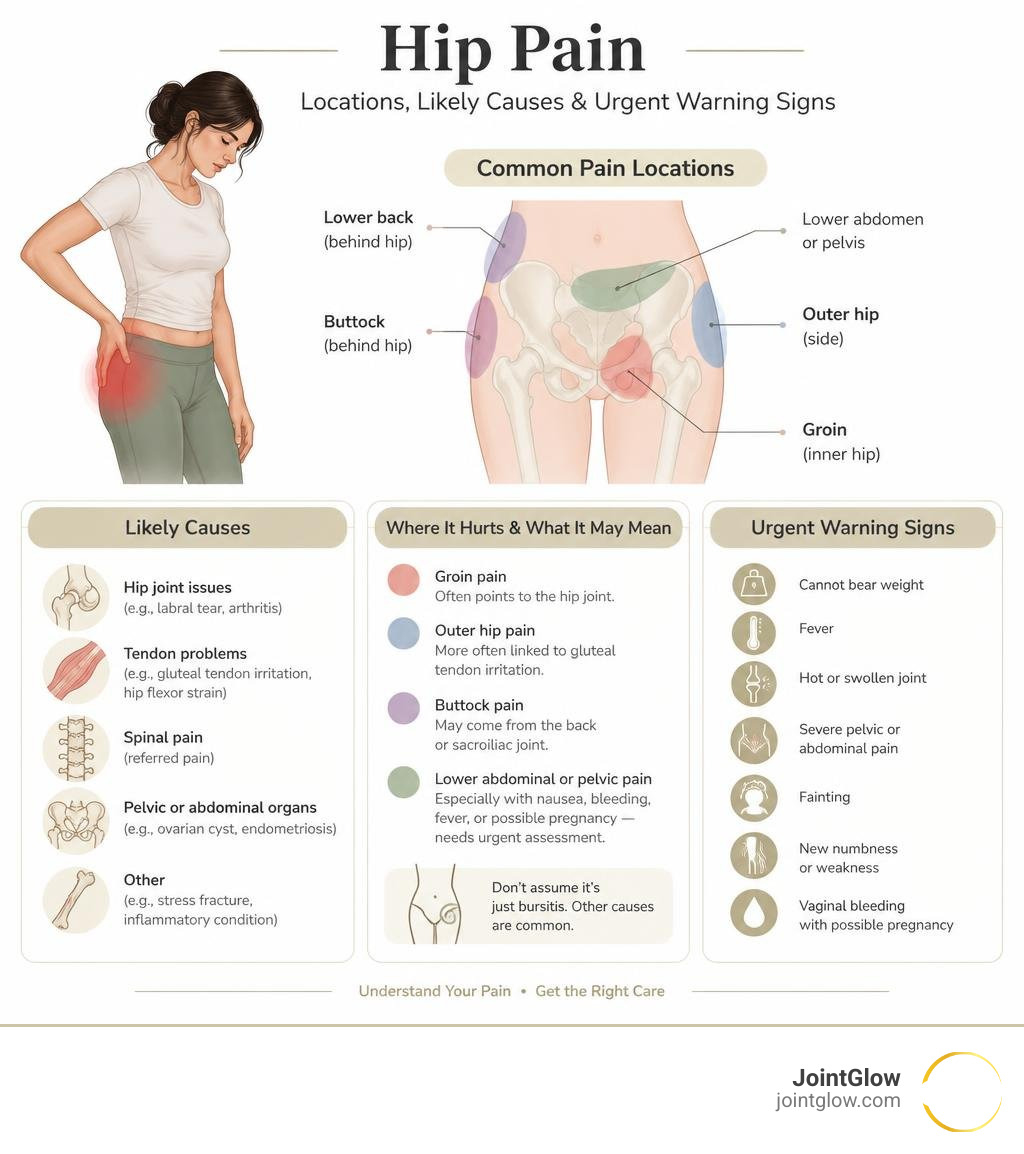
Sudden hip pain without injury in a female can come from the hip joint, nearby tendons, the lower back, the pelvis, or abdominal organs. Groin pain often points to the hip joint; pain on the outer hip is more often linked to gluteal tendon irritation; buttock pain may come from the back or sacroiliac joint. One-sided lower abdominal or pelvic pain, especially with nausea, bleeding, fever, or possible pregnancy, needs urgent medical assessment.
Do not assume it is simply bursitis. Outer-hip pain is often blamed on a bursa, but tendon problems and referred spinal pain are common look-alikes. Sudden pain can also signal a labral tear, arthritis flare, stress fracture, inflammatory condition, ovarian cyst, or endometriosis.
Seek urgent care now if you cannot bear weight, have fever, a hot or swollen joint, severe pelvic or abdominal pain, fainting, new numbness or weakness, or vaginal bleeding with possible pregnancy.
This guide helps you map where the pain is, notice the clues that matter, and choose the right next step. I am Dr. Koneru, and we will start by using pain location to narrow down the likely source.
Pinpointing the Source: How Pain Location Reveals the Cause
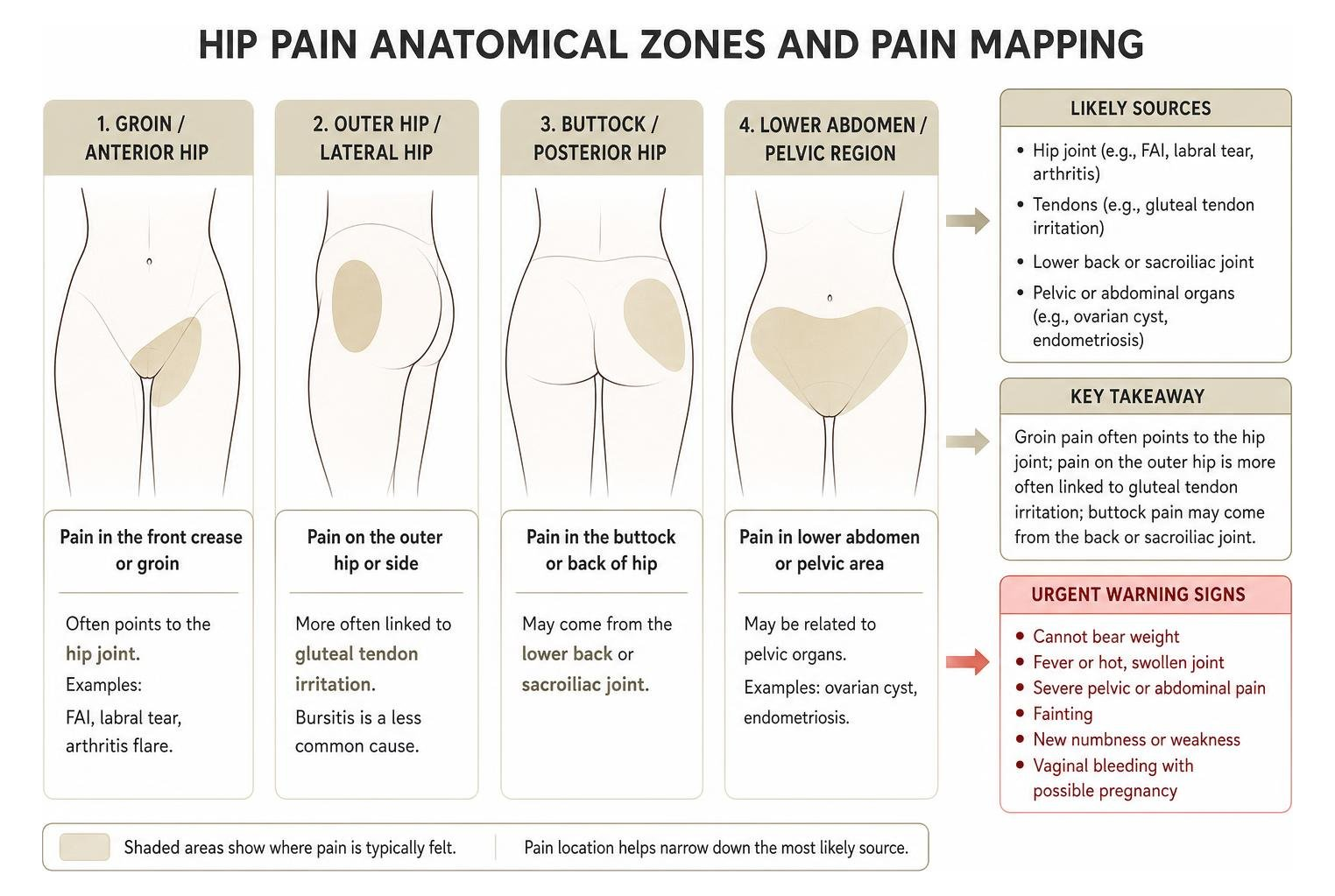
When experiencing sudden discomfort, the exact anatomical zone provides critical clues. The pelvic architecture in women is broad, housing a network of interconnected nerves, soft tissues, and reproductive organs.
Because the central nervous system often shares sensory pathways across the pelvis, it is easy to mistake organ distress or spinal compression for a true ball-and-socket issue. Evaluating pelvic and lower quadrant pain in women requires mapping the pain into distinct diagnostic regions.
Groin and Anterior Hip Pain
Discomfort concentrated directly in the front crease of the hip or groin almost always reflects intra-articular pathology—meaning the problem sits inside the actual hip joint. Common culprits include:
- Femoroacetabular Impingement (FAI): Structural irregularities where the femoral head rubs against the acetabular rim.
- Acetabular Labral Tears: Disruption of the fibrocartilage ring stabilizing the socket.
- Iliopsoas Tendinitis: Inflammation of the deep flexor tendon crossing the front of the joint.
- Osteoarthritis: Degradation of the protective articular cartilage.
Understanding underlying hip joint conditions helps identify why simple daily actions—such as putting on socks or getting out of a car—suddenly trigger anterior pinching sensations.
Lateral and Outer Hip Pain
Pain localized over the bony prominence on the side of the pelvis (the greater trochanter) is exceptionally common in females. While historically labeled as bursitis, modern diagnostic imaging reveals that nearly 90% of outer hip pain stems from gluteal tendinopathy rather than isolated bursal fluid.
Lateral pain frequently flares when sleeping on the affected side, sitting with legs crossed, or climbing stairs due to iliotibial (IT) band friction over the abductor tendons.
Posterior Pelvic and Buttock Pain
Ache radiating into the deep gluteal region or posterior pelvis rarely originates from the ball-and-socket joint itself. Common drivers include:
- Sacroiliac (SI) Joint Dysfunction: Irritation at the junction between the sacrum and ilium.
- Piriformis Syndrome: Spasming of the deep piriformis muscle compressing the sciatic nerve.
- Lumbar Radiculopathy: Pinched nerve roots in the lower spine (L4–S1) referring sensation downward.
7 Causes of Sudden Hip Pain Without Injury Female Patients Experience
To evaluate these presentations clearly, the following table compares common musculoskeletal conditions with non-orthopedic and gynecological drivers, while considering causes of left-sided female hip discomfort:
| Condition Category | Primary Symptoms | Aggravating Triggers | Characteristic Mechanism |
|---|---|---|---|
| Gluteal Tendinopathy (GTPS) | Lateral ache, tender greater trochanter | Side-sleeping, single-leg stance | Microtears in abductor tendons |
| Labral Tear / FAI | Sharp anterior groin catch, locking | Hip flexion, pivot-twisting | Cartilage rim disruption |
| Gynecological Mimics | Deep pelvic ache radiating to groin | Menstrual cycle, intercourse | Shared obturator/femoral pathways |
| SI Joint Dysfunction | Posterior unilateral pelvic pain | Transitional motions, stairs | Ligamentous laxity, uneven load |
| Avascular Necrosis | Sudden deep groin pain at rest | Weight-bearing, walking | Bone microvascular compromise |
| Inflammatory Arthritis | Morning stiffness >30 min, warmth | Prolonged rest, immobility | Systemic autoimmune synovitis |
| Lumbar Nerve Compression | Shooting buttock or thigh tingling | Bending, coughing, sneezing | Nerve root impingement (L4-S1) |
1. Greater Trochanteric Pain Syndrome (GTPS)
Greater Trochanteric Pain Syndrome encompasses chronic irritation and microtears of the gluteus medius and minimus tendons, occasionally paired with inflammation of the overlying bursa.
Because women possess wider pelvic angles (Q-angles), their abductor tendons endure higher tensile loads during walking and standing. GTPS frequently triggers intense night-time aching, making direct pressure while side-sleeping uncomfortable.
2. Acetabular Labral Tears and Hip Impingement
The labrum is a specialized ring of rubbery cartilage that cushions and seals the hip joint. In active women or individuals with subtle bone variations (such as cam or pincer morphology), twisting or squatting can suddenly tear this structure.
Patients often describe an unmistakable clicking, popping, or catching sensation deep in the groin crease, accompanied by limited rotational range of motion.
3. Gynecological Causes of Sudden Hip Pain Without Injury Female Sufferers Overlook
Non-musculoskeletal issues frequently manifest as joint pain. Pelvic organs share sensory nerve roots (specifically the obturator and genitofemoral nerves) with the hip and upper inner thigh.
Conditions like endometriosis, enlarging ovarian cysts, uterine fibroids, and pelvic floor muscle spasms can radiate directly to the groin. If hip tightness worsens during ovulation or menstruation, a gynecological origin warrants evaluation.
4. Sacroiliac (SI) Joint Dysfunction and Pelvic Girdle Pain
The SI joints connect the lower spine to the pelvis. In females, fluctuating hormones—particularly relaxin and progesterone during pregnancy, postpartum recovery, or perimenopause—can cause ligamentous laxity.
When these stabilizing ligaments soften, subtle asymmetrical shifts produce sharp, localized discomfort across the lower back, buttock, and groin during single-leg weight-bearing movements.
5. Avascular Necrosis and Bone Insufficiency Fractures
Avascular necrosis (osteonecrosis) occurs when blood flow to the femoral head is temporarily compromised, leading to microstructural collapse.
Similarly, women with osteopenia or osteoporosis can develop spontaneous insufficiency stress fractures in the femoral neck without any traumatic fall. Both conditions demand rapid diagnostic imaging to preserve joint integrity.
6. Acute Inflammatory Arthritis Flare-Ups
While osteoarthritis stems from mechanical wear over time, sudden inflammatory flare-ups arise from conditions like rheumatoid arthritis, psoriatic arthritis, or ankylosing spondylitis.
These autoimmune conditions attack the synovial lining of the joint capsule, producing swelling, heat, and pronounced morning stiffness that takes more than 30 to 45 minutes to ease.
7. Lumbar Spine Nerve Compression
A herniated lumbar disc or foraminal stenosis at the L2–L4 levels frequently sends referred sensations into the lateral hip and groin, mimicking local joint disease.
Known as “pseudo-hip pain,” spinal nerve irritation can be identified by concurrent numbness, tingling down the leg, or pain exacerbated by coughing, sneezing, and prolonged seated postures.
Clinical Evaluation, Red Flags, and Differential Diagnosis
Navigating unexplained hip symptoms requires a disciplined diagnostic process. When conservative measures fail to bring relief, seeking specialist evaluation for female hip issues helps differentiate soft tissue irritation from surgical or systemic pathology.
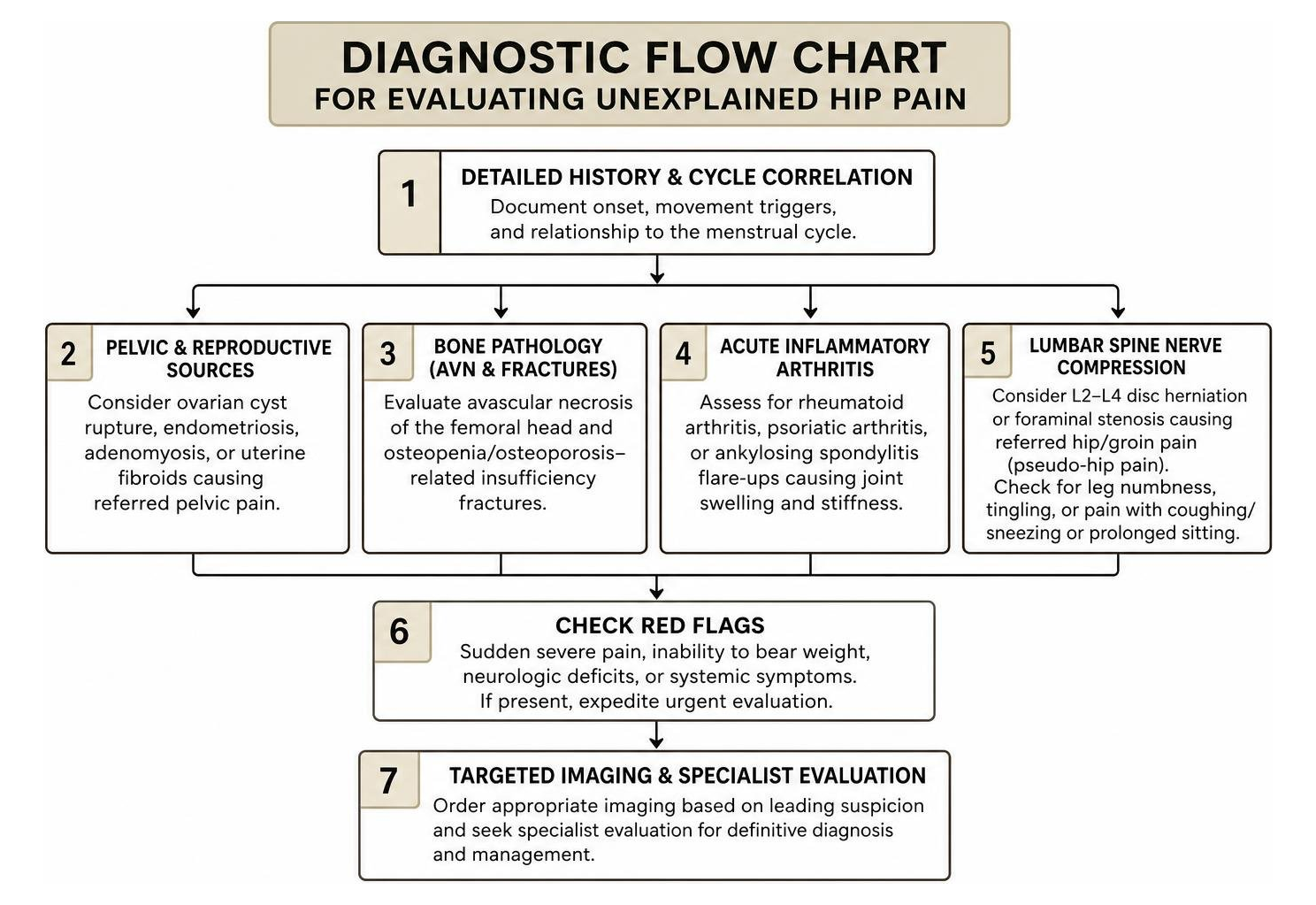
Diagnostic Protocol for Sudden Hip Pain Without Injury Female Cases
A structured clinical evaluation follows these progressive steps:
- Detailed History & Cycle Correlation: Documenting when the pain began, movement triggers, and any relationship to the menstrual cycle.
- Targeted Physical Examination: Conducting functional tests like the FABER (Flexion, Abduction, External Rotation) and FADIR (Flexion, Adduction, Internal Rotation) maneuvers to isolate joint versus tendon pain.
- Pelvic & Hip Radiographs (X-rays): Initial weight-bearing views to assess joint space, bone alignment, and identify underlying structural variations.
- Advanced Imaging (MRI or Ultrasound): Magnetic resonance imaging reveals soft-tissue changes like labral tears, bursal fluid, occult bone edema, or gluteal tendon tears. Diagnostic ultrasound assesses tendon dynamics in real time.
- Laboratory Panels: Blood tests evaluating inflammatory markers (ESR, CRP) or rheumatoid factors when systemic joint disease is suspected.
Critical Red Flags Requiring Immediate Emergency Care
Seek prompt emergency medical care if sudden hip discomfort is accompanied by:
- Complete inability to bear weight on the leg.
- Systemic fever, chills, night sweats, or unexplained weight loss.
- Visible joint deformity, localized redness, or intense heat over the area.
- Sudden one-sided lower abdominal pain accompanied by dizziness, faintness, or abnormal vaginal bleeding.
- Loss of bowel or bladder control, or progressive numbness in the saddle area (groin/inner thighs).
Evidence-Based Relief: From Conservative Self-Care to JointGlow LDRT
For mild to moderate musculoskeletal flare-ups, conservative care is the first line of defense:
- Sleep Positioning: Sleep on your unaffected side with a firm pillow between your knees and ankles to keep the hips, pelvis, and spine neutrally aligned. If sleeping on your back, place a pillow beneath your knees.
- Activity Modification: Temporarily avoid crossing your legs, sitting in low, soft chairs, and high-impact exercises. Replace high-impact running with gentle swimming or stationary cycling.
- Targeted Physical Therapy: Gentle mobility work (such as seated pretzel stretches and hip flexor lengthening) paired with progressive abductor strengthening (clamshells, resistance band side-steps) stabilizes the pelvis.
- Thermal Therapy: Apply ice packs for 15 minutes to soothe acute tendon inflammation, transitioning to moist heat to relax tight surrounding muscles.
When chronic joint irritation persists beyond conservative home measures, exploring advanced non-invasive joint inflammation treatments can help restore mobility without surgery.
Non-Invasive JointGlow LDRT
For women facing persistent joint inflammation from osteoarthritis or chronic inflammatory conditions who want to avoid invasive surgery or ongoing reliance on medications, we offer an innovative clinical approach: Low-Dose Radiotherapy (LDRT).
At JointGlow, our non-invasive, Medicare Part B (Excludes Medicare Advantage) covered low-dose radiotherapy (LDRT) uses ultra-low-dose X-rays to calm hyperactive immune cells, modulate inflammatory cytokines, and biologically reset chronic inflammation inside the joint.
To learn more about how this painless, outpatient therapy delivers fast and durable relief without downtime, explore how radiation therapy for joints works.
Frequently Asked Questions About Female Hip Pain
Review our comprehensive joint pain FAQs for additional insights into persistent joint discomfort.
Can pelvic issues or ovarian cysts actually cause sudden hip pain?
Yes. The pelvic organs share sensory nerve pathways (such as the obturator nerve) with the hip joint and groin. An enlarging ovarian cyst, localized endometriosis, or pelvic floor muscle hypertonicity can present primarily as sharp or aching groin pain that fluctuates with the menstrual cycle.
How do I know if my hip pain is coming from my back instead of the joint?
True hip joint issues typically present with groin pinching during hip flexion (such as tying shoes or climbing stairs). Pain originating in the lumbar spine usually affects the buttocks, radiates down the back or side of the thigh, and changes in intensity during spinal bending, coughing, or prolonged sitting.
What is the best sleeping position when experiencing acute hip pain?
Side-sleeping on the unaffected side with a supportive pillow placed between your knees and ankles offers the best relief. This setup prevents the top leg from dropping forward, relieving rotational stress on the hip joint, abductor tendons, and sacroiliac ligaments.
Conclusion
Sudden, unexplained hip discomfort should never be ignored. Whether driven by tendon strain, joint cartilage irritation, pelvic mechanics, or referred spinal issues, an accurate diagnosis is the cornerstone of lasting relief. By identifying pain locations, recognizing warning signs, and taking proactive steps, you can protect your joint health and stay active.
If chronic joint inflammation is limiting your daily life, explore personalized relief solutions with JointGlow to learn how our non-invasive therapies can help you get back to moving comfortably.
