Non Surgical Joint Pain Relief: Effective Options Before Surgery
You do not have to jump straight from joint pain to surgery. For many people with knee, hip, shoulder, foot, or elbow pain, the best first plan combines targeted exercise, physical therapy, weight and activity changes when appropriate, braces or orthotics, topical treatments, and carefully chosen office-based therapies.
A practical non surgical joint pain relief plan often starts with:
- Build strength and movement tolerance with guided exercise, especially around the painful joint.
- Reduce joint stress with supportive footwear, an unloader brace, or orthotics when alignment is a factor.
- Use lower-risk pain options first, such as topical anti-inflammatory treatments, rather than relying on daily oral medications.
- Consider injections or advanced non-invasive therapies when pain still limits walking, sleep, work, or daily life.
Osteoarthritis and other chronic joint conditions can make ordinary tasks feel harder than they should. Yet pain is not always a sign that an operation is the only answer. Many options can reduce inflammation, improve function, and help you stay active while avoiding the risks and recovery time of surgery.
The key is choosing treatments that fit your joint, health history, goals, and current medications – not simply masking pain with another pill.
Modern Approaches to Non Surgical Joint Pain Relief
Osteoarthritis is the third most common diagnosis among older adults, disabling approximately 10% of Americans over age 60 and carrying an economic burden exceeding $60 billion annually (Mushtaq et al., 2011). For decades, the path for managing joint degradation followed an uninspired route: take pain pills until they upset your stomach, get a series of short-acting joint injections, and eventually undergo major joint replacement surgery.
Fortunately, modern clinical medicine has evolved. Today, we understand that joint pain is not merely mechanical “wear and tear”; it is an active biological state driven by chronic low-grade inflammation within the synovium and surrounding soft tissues.

By targeting the cellular drivers of joint discomfort, non-invasive technologies provide deep, durable relief without requiring an incision or extensive downtime. Understanding the science of inflammation reveals why merely masking symptoms fails over time. Modern therapies focus instead on altering how immune cells behave inside the joint space, calming the cytokine cascades that irritate nerve endings and break down cartilage.
Patients tracking their recovery through the LDRT results timeline often find that biological modulation produces a progressive, sustained return to daily physical activity. Furthermore, many of these advanced non-invasive options are covered by Medicare Part B (Excludes Medicare Advantage), making restorative joint care accessible to older adults who need it most.
Target Inflammation with Advanced Non Surgical Joint Pain Relief Modalities
When joint tissues experience chronic stress, local immune cells—particularly macrophages—shift into a pro-inflammatory state. These activated macrophages release destructive cytokines (including interleukin-1 beta, interleukin-6, and tumor necrosis factor-alpha) that sustain swelling and sensitize peripheral nociceptors.
Advanced therapeutic modalities work by encouraging these cells to transition back to an anti-inflammatory, reparative phenotype. This non-invasive cellular reset is effective across various chronic conditions:
- Knee Osteoarthritis: Calming synovial lining inflammation helps restore walking tolerance and reduces morning stiffness, as detailed in our guide on knee osteoarthritis.
- Hand and Finger Osteoarthritis: Soothing inflamed small joints preserves grip strength and fine motor skills; explore more about hand osteoarthritis.
- Shoulder Bursitis & Rotator Cuff Tendinopathy: Relieving subacromial inflammation helps you sleep on your side again and lift overhead without sharp catches; read about non-operative care for shoulder bursitis & rotator cuff pain.
Low-Dose Radiotherapy: Biologically Resetting Joint Inflammation
One of the most established yet underutilized cellular therapies in modern orthopedic care is low-dose radiotherapy (LDRT). While radiotherapy is historically associated with oncology, the doses used for benign musculoskeletal inflammation are ultra-low—a fraction of diagnostic or oncologic levels.
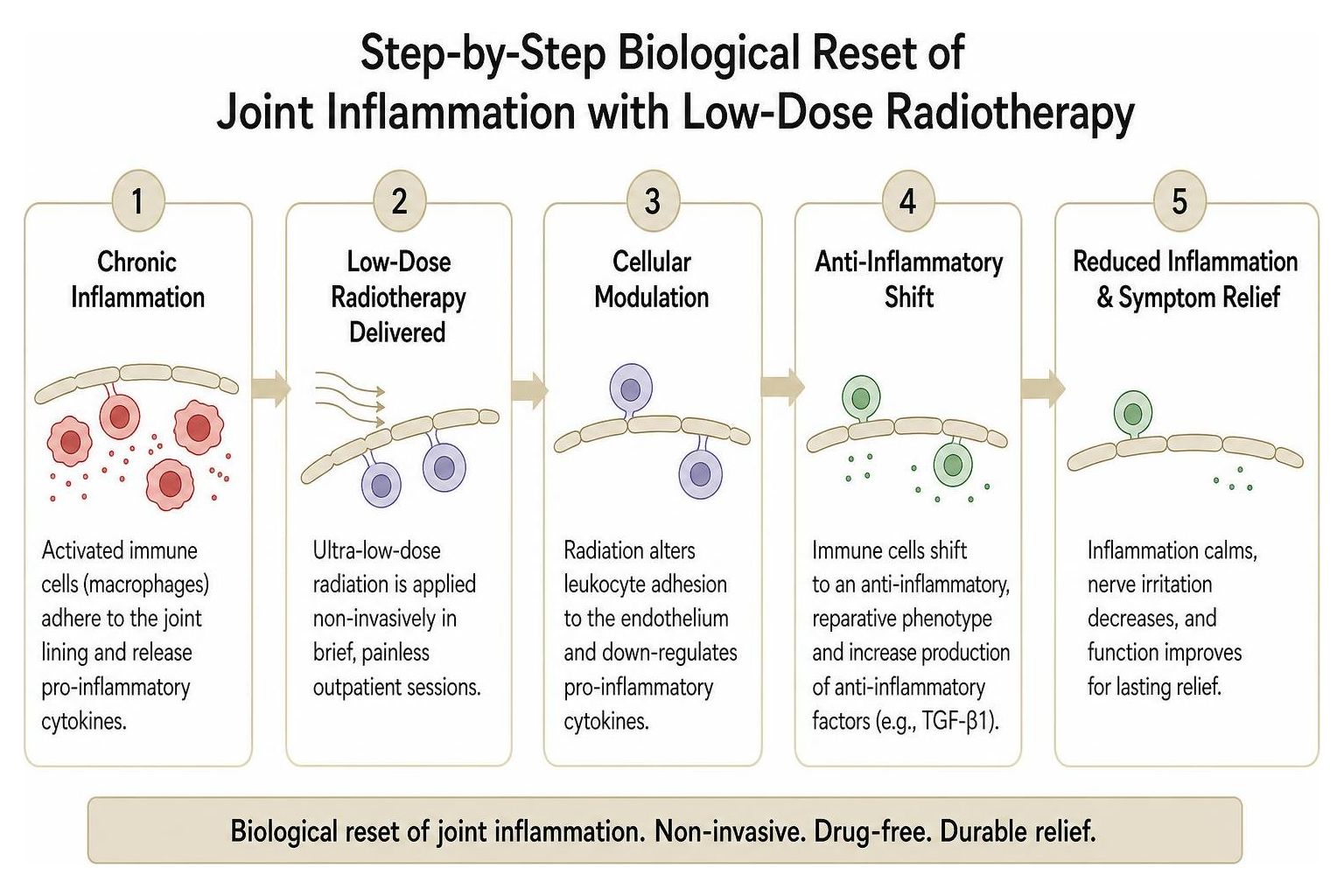
At JointGlow, we deliver non-invasive, Medicare Part B (Excludes Medicare Advantage) covered low-dose radiotherapy to biologically reset chronic inflammation. Rather than destroying cells, ultra-low-dose radiation alters the adhesion of inflammatory leukocytes to endothelial walls, down-regulates pro-inflammatory cytokines, and stimulates anti-inflammatory factors like TGF-beta 1.
Administered in brief, completely painless outpatient sessions, LDRT provides drug-free inflammation control. It does not stress the liver, kidneys, or gastrointestinal tract, making it a viable alternative for patients with complex medical backgrounds.
Comparing Long-Term Cellular Relief to Temporary Interventions
When joint pain flares, patients often turn to fast-acting interventions to get through the day. While temporary measures have their place during acute flare-ups, relying on them indefinitely creates an unpredictable cycle of relief and rebound pain.

To achieve lasting mobility, it is crucial to evaluate whether an intervention simply numbs sensation or works to alter the underlying biological environment of the joint. In our detailed comparison of LDRT vs steroid injections, we examine how continuous cellular reset differs from temporary symptom suppressors.
Addressing Root Causes vs. Temporary Symptom Masking
Intra-articular corticosteroid injections provide rapid relief by shutting down localized inflammation, but their benefits are often brief, typically lasting only 1 to 3 weeks (Mushtaq et al., 2011). Repeated steroid injections have also been linked to accelerated cartilage loss and elevated systemic blood glucose levels.
Emerging biological therapies aim for deeper, more sustained modulation:
- Platelet-Rich Plasma (PRP): In a randomized trial comparing intra-articular PRP to corticosteroids and NSAIDs in late-stage knee osteoarthritis, two weekly injections of PRP significantly reduced Visual Analogue Scale (VAS) pain scores and lowered pro-inflammatory serum biomarkers (such as COMP, MMP-3, IL-6, and TNF-alpha) for up to 6 months while reducing patient opioid requirements (Mushtaq et al., 2011).
- Intra-Articular Ozone Therapy: Clinical trials evaluating medical ozone have demonstrated that concentrations of 20 µg/mL significantly improve functional mobility on the Timed Up and Go (TUG) and 6-Minute Walk Test (6MWT) by inducing mild, therapeutic hormetic antioxidant pathways.
- High-Intensity Laser Therapy (HILT): Class IV laser therapy delivers photobiomodulation deep into periarticular tissues, demonstrating superior clinical pain reduction compared to topical phonophoresis.
By focusing on treatments that modulate cellular signaling, patients can achieve sustained comfort rather than living between injection cycles.
Thermal and Conservative Supportive Modalities
Basic conservative tools remain foundational for managing daily stiffness and mild flare-ups at home:
- Superficial Heat Therapy: Applying moist heat wraps for 15–20 minutes increases local microcirculation, enhances connective tissue elasticity, and relaxes protective muscle spasms around arthritic joints.
- Cryotherapy (Cold Packs): Applying cold packs for 10–15 minutes following physical exertion constricts local blood vessels, blunts acute nerve conduction, and minimizes post-activity swelling.
- Pulsed Electromagnetic Field (PEMF) Devices: Non-invasive, wearable PEMF systems provide localized stimulation that helps regulate soft-tissue inflammatory signaling throughout the day (Hackel et al., 2025).
Topical Formulations and Safe Pharmacologic Strategies
For many older adults, taking systemic pain medications is not a straightforward choice. Managing multiple prescriptions makes avoiding adverse drug interactions and organ toxicity a primary clinical goal.
| Therapy Class | Mechanism of Action | Common Examples | Primary Clinical Benefits | Safety Considerations & Geriatric Risks |
|---|---|---|---|---|
| Topical NSAIDs | Local COX-2 enzyme inhibition via skin absorption | Diclofenac gel (1%), Voltaren | 42–45% pain reduction; 158-fold lower systemic blood concentration | Mild localized skin irritation; minimal GI/renal risk |
| Topical Phytochemicals | NF-kB down-regulation & TRPV1 modulation | Curcumin gel (VAS-101), Capsaicin cream | Targeted anti-inflammatory action; 14.9% pain reduction (VAS-101) | Transient skin staining; temporary application site burning (capsaicin) |
| Oral Acetaminophen | Central prostaglandin synthesis inhibition | Tylenol, Paracetamol | First-line mild analgesic; no GI mucosal damage | Inferior efficacy to NSAIDs; potential hepatic toxicity at doses >3g/day |
| Oral NSAIDs / COX-2 Inhibitors | Systemic prostaglandin and COX enzyme suppression | Celecoxib, Naproxen, Ibuprofen | Superior pain and joint stiffness relief across multiple trials | 2x higher GI toxicity/hospitalization in over-65s; renal and cardiovascular risks |
| Centrally Acting Analgesics | Serotonin/Norepinephrine reuptake inhibition (SNRI) | Duloxetine (Cymbalta) | >30% pain reduction in 65.3% of knee OA patients; treats central sensitization | Nausea, dry mouth, dizziness, fall risk in vulnerable older adults |
| Low-Dose Radiotherapy (LDRT) | Macrophage phenotype reset; cytokine suppression | JointGlow LDRT protocol | Non-invasive, durable, drug-free relief; zero systemic side effects | Requires clinic attendance; contraindicated in active pregnancy |
Topical NSAIDs and Phytochemical Gels
Topical therapies deliver active anti-inflammatory compounds directly through the dermis to saturated periarticular tissues. Because topical diclofenac delivers roughly 158-fold lower systemic plasma concentrations than oral pills, it effectively calms joint flares while sparing the digestive tract and kidneys (Mushtaq et al., 2011).
Natural phytochemicals are also showing encouraging results in rigorous clinical trials:
- A 28-day randomized, double-blind, placebo-controlled study evaluated a transdermal curcumin formulation. Knee Injury and Osteoarthritis Outcome Score (KOOS) pain ratings improved by 14.9% in the curcumin group compared to 6.5% in the placebo group.
- In the same trial, 39.3% of curcumin-treated patients reported feeling “much or very much improved” (versus 13.3% for placebo), and 32.1% achieved a Minimal Clinically Important Difference (MCID) with no serious side effects beyond temporary, harmless skin staining.
- Meta-analyses of oral curcumin encompassing 2,175 knee OA patients have similarly demonstrated meaningful self-reported pain relief and a noticeable reduction in the need for rescue analgesics.
Managing Oral Analgesics and Minimizing Polypharmacy
When oral medications are necessary, selecting the safest effective option is critical (Mushtaq et al., 2011):
- Acetaminophen Limitations: While traditionally recommended as a first-line therapy due to its safety profile, systematic reviews of 15 randomized controlled trials indicate that acetaminophen provides modest pain relief that is often clinically inferior to NSAIDs for moderate-to-severe joint stiffness and swelling (Mushtaq et al., 2011). Doses must remain strictly below 3,000 mg daily to avoid hepatic injury.
- Navigating NSAID Risks: Non-selective oral NSAIDs carry considerable risks for older adults. In population-based cohort studies of patients aged 65 and older, gastrointestinal toxicity and hospitalization rates were twice as high among those taking non-selective NSAIDs compared to those prescribed selective COX-2 inhibitors (celecoxib) or NSAIDs co-prescribed with a proton-pump inhibitor (PPI) (Mushtaq et al., 2011). Renal and cardiovascular monitoring is essential.
- Addressing Central Sensitization: When chronic joint pain alters central nervous system processing, the SNRI duloxetine can be effective. In a 13-week trial for knee OA, 65.3% of duloxetine-treated patients achieved a greater than 30% reduction in pain, compared to 44.1% on placebo (Mushtaq et al., 2011).
- Avoiding Opioids: In a meta-analysis of 41 clinical trials with over 6,000 chronic pain patients, strong opioids like morphine and oxycodone improved pain scores over acetaminophen and naproxen, but failed to produce meaningful improvements in physical function while introducing risks of sedation, falls, constipation, and dependency (Mushtaq et al., 2011).
Looking ahead, emerging biologic therapies targeting nerve growth factor (NGF inhibition) and interleukin-1 pathways (IL-1 blockade) continue to be evaluated to interrupt joint pain signaling without standard analgesic risks (Mushtaq et al., 2011).
Biomechanical Support and Physical Rehabilitation
External load distribution plays a vital role in joint preservation. Proper alignment decreases stress on vulnerable cartilage, allowing biological therapies to work more effectively.
Every extra pound of body weight transmits roughly four pounds of mechanical pressure across the knee joint during daily ambulation. Combining modest weight reduction with structured physical therapy creates an optimal mechanical environment for tissue recovery. Review our overview of treatable conditions to see how biomechanical support integrates with non-invasive therapies.
Evidence-Based Non-Pharmacologic Care for Non Surgical Joint Pain Relief
Structured, non-pharmacologic interventions form the backbone of joint management:
- Targeted Muscle Strengthening: Supervised exercise focusing on the quadriceps and hip abductor muscle groups stabilizes the pelvis and knee, reducing uneven joint compartment loading during the stance phase of walking (Mushtaq et al., 2011).
- Biomechanical Unloader Bracing: For medial compartment knee osteoarthritis, lightweight unloader braces apply a gentle valgus force that widens the narrowed joint space, reducing bone-on-bone friction during movement.
- Lateral-Wedged Insoles: Podiatric evaluation and custom lateral-wedged orthotics help realign the mechanical load axis in varus knee alignment. Controlled trials have demonstrated significant reductions in daily oral pain medication use at 6-month and 2-year follow-ups among patients using wedged insoles (Mushtaq et al., 2011).
- Patellar Taping: Kinesiology and rigid taping techniques help realign the patella within the trochlear groove, offering an inexpensive, low-risk method to ease pain during stairs and squatting (Mushtaq et al., 2011).
Frequently Asked Questions About Non-Invasive Joint Care
What is the safest non-surgical treatment for chronic joint pain in older adults?
The safest non-surgical approach combines non-pharmacologic physical therapy, biomechanical unloading (such as orthotics or bracing), topical anti-inflammatories, and low-dose radiotherapy. These options provide localized relief without systemic gastrointestinal, cardiovascular, or renal side effects (Mushtaq et al., 2011).
How quickly do non-invasive joint therapies provide lasting relief?
Response times vary based on the modality. Topical NSAIDs and thermal therapies offer immediate, temporary relief within hours. Cellular therapies like low-dose radiotherapy (LDRT) and platelet-rich plasma (PRP) work progressively: biological modulation develops over 3 to 8 weeks, leading to sustained functional improvements that can last for months or years.
Are non-surgical treatments for joint pain covered by Medicare?
Yes. Medicare Part B covers medically necessary non-surgical joint interventions, including physical therapy, custom bracing, diagnostic imaging, and low-dose radiotherapy (LDRT) for chronic inflammatory joint conditions, provided clinical criteria are met.
Conclusion: Finding the Right Path to Long-Term Joint Comfort
Joint pain does not mean you must resign yourself to invasive surgery or indefinitely cope with medication side effects. By integrating targeted physical rehabilitation, smart biomechanical unloading, safe topical anti-inflammatories, and modern cellular therapies like low-dose radiotherapy, you can take control of your mobility.
At JointGlow, we focus on treating the underlying biological inflammation that drives chronic joint pain. Our non-invasive, Medicare Part B (Excludes Medicare Advantage) LDRT protocols deliver drug-free, durable relief with zero surgical downtime. You can preserve your natural joints, protect your overall health, and return to moving comfortably. Take your next step and start your journey toward non-surgical joint pain relief today.
References
Mushtaq S, Choudhary R, Scanzello CR. “Non-surgical treatment of osteoarthritis-related pain in the elderly..” Current reviews in musculoskeletal medicine, 2011. PMCID PMC3261252. Hackel JG, Paci JM, Gupta S, Maravelas DA, North TJ, Paunescu A. “Evaluating Noninvasive Pulsed Electromagnetic Field Therapy for Joint and Soft Tissue Pain Management: A Prospective, Multi-center, Randomized Clinical Trial..” Pain and therapy, 2025. PMCID PMC11914662.
