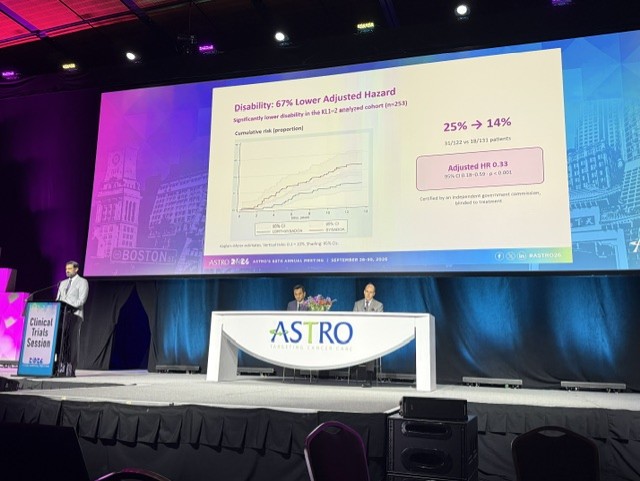
The short answer: In a randomized trial of 292 adults with early knee osteoarthritis followed for a median of 11.9 years, adding low-dose radiation therapy (LDRT) to glucosamine and chondroitin was linked to longer-lasting pain relief, less joint deterioration on MRI and a 67% lower adjusted hazard of osteoarthritis-related disability. The results were presented on September 27, 2026, at the American Society for Radiation Oncology (ASTRO) Annual Meeting in Boston.
Bobby Koneru, MD, FASTRO, co-founder and chief medical officer of JointGlow, presented the study in ASTRO’s Clinical Trials Session. ASTRO featured it in an official news release and a news briefing for reporters. Below is what the trial found, what it doesn’t prove yet, and what it could mean if you live with knee osteoarthritis pain.
Key takeaways
Lasting relief: Both groups felt better at first, but only the LDRT group’s pain relief held up over time, along with greater gains in physical function and quality of life.
Less joint damage on MRI: Structural scores improved slightly with LDRT at 12 months and worsened with medication alone. The gap was still there at 36 months.
Less disability: LDRT was associated with a 67% lower adjusted hazard of government-certified disability from knee osteoarthritis (adjusted HR 0.33).
Biggest benefit in grade 2 knees: Disability affected 31% of LDRT patients vs. 61% on medication alone. Knee replacement: 14% vs. 36%.
Safety so far: No acute radiation reactions or cancers in the treated area were reported during follow-up. The study was not designed to measure rare late effects.
What’s next: Researchers are calling for a multicenter trial that uses simulated (sham) radiation as the control.
What did the ASTRO 2026 knee osteoarthritis study find?
Earlier reports from this trial looked at symptoms, MRI findings and long-term outcomes one at a time. The 2026 analysis looked at all three together, and all three favored LDRT.
Outcome
LDRT + medication
Medication alone
Result
Pain, function and quality of life
Improvement sustained over time
Early improvement not sustained
Favored LDRT
MRI structural score (WORMS), change at 12 months
−0.3 (slight improvement)
+0.9 (worsening)
Favored LDRT (p = 0.02)
MRI structural score (WORMS), change at 36 months
+0.5
+2.3
Favored LDRT (p = 0.01)
Government-certified disability, study population
—
—
67% lower adjusted hazard (HR 0.33; 95% CI 0.18–0.59; p < 0.001)
Sources:ASTRO news release, Sept. 27, 2026;study abstract. WORMS = Whole-Organ Magnetic Resonance Imaging Score; higher scores mean more joint damage, so a smaller increase is better.
“The most compelling part of this study is how the outcomes fit together,” Dr. Koneru said in ASTRO’s release. That consistency, he noted, “raises the possibility that treatment may influence the longer course of osteoarthritis,” not only its symptoms.
“For osteoarthritis, we have treatments that can help patients feel better, but much less evidence that they can change what is happening inside the joint. What makes these findings interesting is that the patient-reported improvement was accompanied by a measurable difference on MRI. That moves the question beyond pain relief alone.”
— Gopal K. Bajaj, MD, MBA, FASTRO, co-chair of ASTRO’s Functional Radiation Medicine Task Force
Who was in the trial, and how was LDRT given?
Researchers at a single institution in Russia randomly assigned 292 adults with symptomatic knee osteoarthritis between 2012 and 2014. Everyone had early disease (Kellgren-Lawrence grade 0, 1 or 2), and participants were relatively young, with a median age of 38.
Study at a glance
Design
Randomized controlled trial; integrated analysis of patient-reported, MRI and long-term clinical outcomes
Where
Single institution in Russia; lead investigators at Northern State Medical University, Arkhangelsk
Enrollment
2012–2014
Participants
292 adults with symptomatic knee osteoarthritis, Kellgren-Lawrence grade 0–2; median age 38
Comparison
Glucosamine and chondroitin alone (146 patients) vs. the same medication plus LDRT (146 patients)
LDRT dose
4.5 Gy total in 10 sessions, delivered with low-energy (orthovoltage) X-rays
Follow-up
MRI through 36 months; regional health records for a median of 11.9 years
Measures
Pain, WOMAC function scores, SF-36 quality of life, MRI (WORMS), government-certified disability, knee replacement
Presented
Sept. 27, 2026, ASTRO Clinical Trials Session (CT 01), Boston
Two terms worth knowing: the Kellgren-Lawrence (KL) scale grades knee osteoarthritis on X-ray from 0 (no signs) to 4 (severe); grade 2 means definite bone spurs with possible narrowing of the joint space. A gray (Gy) is the unit used to measure radiation dose.
Why grade 2 knees may be a “window” for treatment
The largest absolute benefit came in the 78 patients with grade 2 disease, where osteoarthritis was established but not yet advanced. In that group, disability developed in 31% of patients who received LDRT versus 61% on medication alone, and 14% needed a knee replacement versus 36%.
“Grade 2 disease may represent a window where osteoarthritis is established but extensive joint damage has not yet occurred,” Dr. Koneru said. In his presentation, he noted that disability was certified by an independent government commission that was blinded to treatment.
Because the grade 2 results come from a subgroup, Dr. Koneru said the next trial should focus on grade 2 patients to test them directly.
What this study does and doesn’t prove
The results are encouraging, and ASTRO and the researchers were clear about the study’s limits:
No sham control. The comparison group took medication only and did not receive simulated radiation. The proposed next trial adds that control.
One center, younger patients. All patients were treated at one institution in Russia, and their median age was 38. Results may differ in older adults or in people with more advanced (grade 3–4) arthritis, who were not included.
Long-term safety. No acute radiation reactions or cancers in the treated area were reported. However, ASTRO noted the study “was not designed to quantify rare late effects or lifetime cancer risk,” particularly in such a young group.
Knee replacement overall. Across all patients, the difference in knee replacements favored LDRT but was not statistically significant.
Dr. Koneru said the next step should be a multicenter randomized trial that uses simulated radiation as the control, with prospectively defined imaging and long-term endpoints. Dr. Bajaj said the disability data “add another reason to test whether low-dose radiation can affect the course of early osteoarthritis in a larger, rigorously controlled trial.”
How this study fits with other LDRT research
Sham-controlled evidence: At ASTRO 2025, a Korean trial of 114 patients at three academic centers compared two LDRT doses with sham radiation. In the 3 Gy group, 70% of patients met responder criteria vs. 42% with sham; a very low 0.3 Gy dose did not differ significantly from sham.
Long use in Europe: In Germany, more than one-third of all radiation therapy treatments are for benign conditions, including more than 15,000 patients with osteoarthritis, according to a 2022 review in the International Journal of Radiation Oncology, Biology, Physics.
FDA clearance: In March 2026, Siemens Healthineers announced FDA 510(k) clearance for its Varian TrueBeam, TrueBeam STx, VitalBeam and Edge systems to deliver LDRT for adults with medically refractory osteoarthritis.
Professional guidance: Dr. Koneru also co-authored 2026 American Radium Society guidance on LDRT. Read our summary, or browse more studies on our research page.
What LDRT at JointGlow looks like
Non-surgical: No incisions, needles, drugs or anesthesia.
Short course: Typically 6 to 10 sessions over two to three weeks.
Quick visits: Each treatment takes about five minutes, and most patients are in and out in under 15 minutes, including check-in.
No downtime: Most patients drive themselves and go about their day as normal.
Gradual relief: First signs of improvement often appear within two to four weeks, and relief is typically well established by three to six months. See the LDRT results timeline.
Treatment protocols vary by clinic and equipment. The ASTRO trial used 4.5 Gy over 10 sessions on an orthovoltage machine; your JointGlow physician will explain the protocol recommended for your knee. Learn more about how LDRT works and LDRT treatment at JointGlow.
LDRT isn’t right for everyone. A JointGlow physician reviews your imaging, history and goals to see whether it fits your situation.
Talk with a JointGlow specialist
If knee pain has lasted three months or more and medication, physical therapy or injections haven’t given you lasting relief, ask whether LDRT is an option. Request a consultation or call 407-790-7700. JointGlow’s main office is at 1561 W. Fairbanks Ave., Suite 200, Winter Park, Florida.
Beyond the podium, JointGlow joined CQ Medical, a radiotherapy patient positioning and immobilization company, at its exhibit in Boston for a series of JointGlow Expert Talks:
Evolving Role of LDRT for Nonmalignant Indications.Evan Thomas, MD, PhD (Sunday)
Updates in LDRT for OA + Plantar Fasciitis. Dr. Koneru and David Barron, MD, PhD, VP of Clinical Training & Certifications for LDRT in Benign Disease Treatment (Monday)
Meet the Expert Q&A. Dr. Barron (Tuesday)
Dr. Barron also co-led hands-on education with CQ Medical on LDRT’s biological mechanisms, clinical indications and the positioning tools that support accurate, repeatable treatment. Precise, comfortable positioning is what keeps a low dose focused on the joint and away from surrounding tissue.
In the news after ASTRO
ASTRO distributed the findings on September 27, 2026, through EurekAlert!, the science news service of the American Association for the Advancement of Science. Coverage included:
U.S. News & World Report and HealthDay: “Low-Dose Radiation Could Help Slow Knee Arthritis” (Sept. 30) U.S. News · HealthDay
Does low-dose radiation therapy work for knee osteoarthritis?
The evidence is promising but still developing. A sham-controlled Korean trial presented at ASTRO 2025 found short-term pain and function benefits at a 3 Gy dose, and the 12-year randomized trial presented at ASTRO 2026 linked LDRT to longer-lasting relief, less deterioration on MRI and less disability. Larger sham-controlled trials are planned.
What did the ASTRO 2026 knee osteoarthritis study find?
Among 292 adults with early knee osteoarthritis followed for a median of 11.9 years, adding LDRT to glucosamine and chondroitin was linked to longer-lasting pain relief, less structural deterioration on MRI and a 67% lower adjusted hazard of osteoarthritis-related disability. In grade 2 knees, 14% of LDRT patients needed a knee replacement versus 36% on medication alone.
Who presented the ASTRO 2026 LDRT knee study?
Bobby Koneru, MD, FASTRO, a radiation oncologist and co-founder and chief medical officer of JointGlow, presented it on September 27, 2026, in ASTRO’s Clinical Trials Session in Boston.
How is LDRT different from radiation for cancer?
Cancer radiation uses high doses intended to destroy tumor cells. LDRT for osteoarthritis uses a small fraction of that dose and is thought to work mainly by calming inflammation in the joint. The ASTRO 2026 trial used 4.5 Gy in total, spread over 10 sessions.
Who is the best candidate for LDRT?
In this trial, the strongest results were in grade 2 knee osteoarthritis, where the disease is established but the joint is not yet badly damaged. More broadly, people whose knee pain has lasted three months or more without lasting relief from medication, therapy or injections may be candidates. A physician must review each patient’s imaging and history.
Is low-dose radiation therapy for the knee safe?
No acute radiation reactions or cancers in the treated area were reported over nearly 12 years of follow-up. The study was not designed to measure rare late effects or lifetime cancer risk, especially in younger patients, and larger trials are planned. Your physician will discuss the risks for your situation.
Can I still have a knee replacement after LDRT?
Yes. LDRT is non-invasive and does not rule out a knee replacement later if one becomes necessary. In this trial, some patients in both groups eventually had knee replacements.
Is LDRT FDA-cleared?
The FDA clears devices rather than treatments. In March 2026, Varian TrueBeam, TrueBeam STx, VitalBeam and Edge systems received FDA 510(k) clearance for LDRT in adults with medically refractory osteoarthritis. Ask your provider which system your treatment uses.
How many LDRT sessions does treatment take at JointGlow?
Most courses are 6 to 10 sessions over two to three weeks. Each treatment takes about five minutes, and most patients are in and out in under 15 minutes, including check-in.
Is JointGlow’s treatment the same as the one in the study?
Not necessarily. The trial delivered 4.5 Gy in 10 sessions with an orthovoltage machine at one institution in Russia. Protocols and equipment vary between clinics, and your JointGlow physician will explain the plan recommended for you.
This article is for general education and isn’t medical advice. Talk with your physician about your situation.